The Last Practice
Valentina, 19, was the star of the university club team — until she stopped training and her arrogance cost them the championship. After the final, she throws herself into Coach Hale’s arms, devastated. He holds her. Then he tells her he is going to take that brattiness out of her.
The lights in the main gym were already off when he said my name. The championship banners were still hanging. The scoreboard was dark. I followed him into the training room with my arms around myself and the taste of the final still in my mouth.
I’m Valentina. I’m nineteen, a second-year student at the university, and I play outside hitter for the club team. They call me Vale. I wear number 7, and until tonight I thought that number meant I could get away with anything.
Coach Marcus Hale is fifty. He has run this program for twelve years. He is tall, dark hair going gray, a short beard he keeps neat, and he wears the same navy polo to every practice and every match. He is not a man who yells. He is a man who looks at you until you stop pretending.
I was his star. I need that on the record, because it is the beginning of why we lost. I have been the best player on every team I have touched since I was sixteen. I can hit a ball out of the lights. I can run a slide in my sleep. Last season I was conference player of the year, and the local paper ran a photograph of me in this same jersey, arm cocked, and Coach Hale standing on the sideline with his arms folded, looking proud and a little afraid, as if he already knew what pride could do to a girl like me.
He believed in me. That is the part that sits in my chest tonight. He stayed late to feed me balls when my timing was off. He drove me home after a midweek game when my roommate had the car. He told the athletic director I was the reason we would win a championship. I wanted to be that person. And then, a month before the final, I stopped being her.
I skipped practice. First it was once, then it was twice, then it was a week. Midterms, I said. A family thing, I said. The truth was simpler and uglier: I thought I was already good enough. I thought the work was for the others.
He asked me to come. He asked more than once, and I answered him like a girl who had forgotten who had made her.
“Relax, Coach,” I told him in the hallway, after I had missed Thursday and Friday both. “I could run this offense in my sleep. You’re worrying for nothing.”
A week later I did show up to practice, late, and I sat on the bench with my phone in my hand while the others ran a hitting drill behind me. He walked over and pointed at the court, his face tight with anger.
“I’ve got it covered,” I said, and I smirked and waved him off, as if he were interrupting something that mattered more. “The others need the practice. I don’t.”
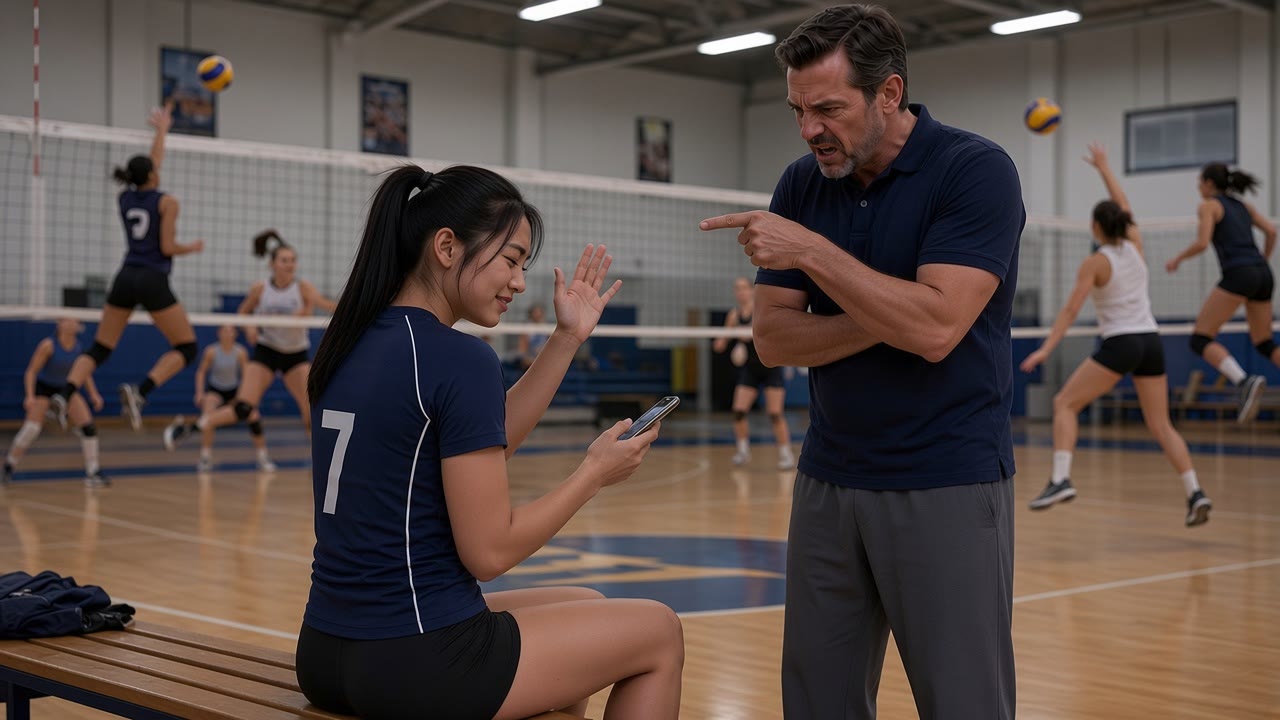
He looked at me for a long time, the way he looks at a serve that is going to land just long. He did not raise his voice. He said, “Vale. This is not a game you can talk into existence. Come tomorrow.”
I said I would. I didn’t. I went to a party instead, and I told myself, dancing, that I would make it up in the match. I was nineteen and certain. I was a fool.
The final was on Saturday night, packed gym, our house, the championship we had been pointing at since August. We were favored. I walked onto the court feeling like the room already belonged to me, and for one set it did. We took the first 25–21. I had four kills and a block and I looked at him, once, as if to say, you see?
Then the game found me.
I missed a serve in the second set and we dropped it 23–25. In the third I shanked a receive that our libero, Camila, had no chance to save, and I hit long on a ball I have put away a thousand times, and we lost that one 22–25. In the fourth, at 24–23 to them, match point, I swung out. The ball was high and I was late, and I knew it as soon as I left the floor. I heard it land. I heard the other bench explode. I heard Camila make a sound I will not forget, and when I turned, my teammates were already crying, and Coach Hale was standing with his arms crossed, stern, looking at me as if he were seeing a thing he had tried, for a month, not to see.
We lost 3–1. The scoreboard said it in red over a packed, silent gym. I dropped to my knees on the court with my hands on my head, and I stayed there, and Camila and the others came around me crying, and he did not come closer. It was my fault. I can write that without flinching now, because the whole gym already knew it, and because I knew it before the last ball even came down.
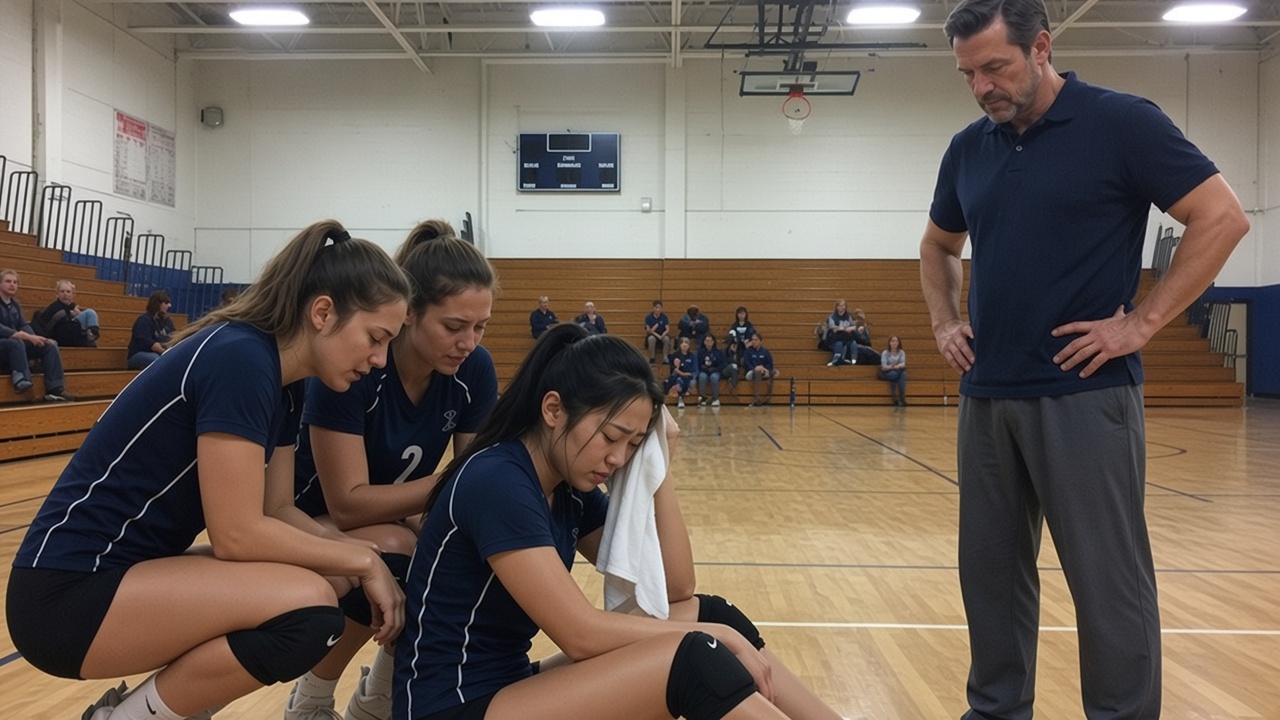
I stayed on my knees with my jersey stuck to my back until I could stand. Someone had brought their little sister a poster with my number on it. It was still in the stands, face down. I had never felt smaller in my life. I had never wanted, so badly, to be someone else.
The locker room was quiet in the way a room is quiet when nobody can stand to look at you. I peeled off the spandex shorts and pulled the jersey back on over my black briefs because I could not bear to be in that room another minute, and I sat there until the others had gone, until Camila had squeezed my shoulder once and left without saying it was all right, because it wasn’t.
Coach Hale found me in the corridor.
“The training room,” he said. “Now, Vale.”
I followed him. The training room is the small one off the main gym: a single poster of a player going up for a kill, the blue mats, the tactics whiteboard still marked with the rotation he had drawn for a match we did not finish the way he had drawn it. The overhead lights hummed. The whiteboard still had his handwriting on it, the fifth rotation, an arrow I had ignored in the fourth set. My sneakers and his were already in a pile by the rolled mat, from the warm-up I had barely taken seriously. I closed the door behind me, and the silence was complete, and I could not hold myself up anymore.
I threw myself at him.
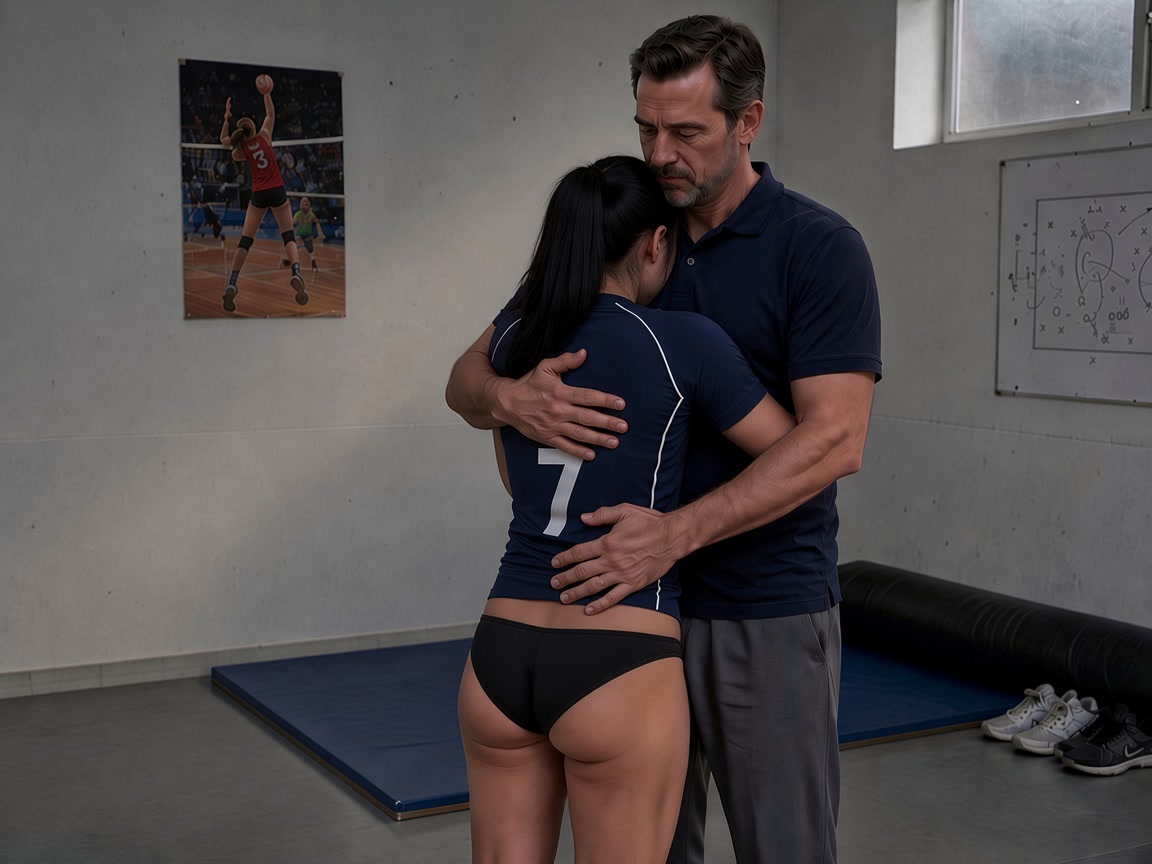
I don’t have a better way to say it. I crossed the room and I went into his chest and I hid my face in the navy polo and I held on, and I was crying, hard, the kind of crying that has no dignity left in it. I was nineteen and I had just cost my whole team a championship, and I wanted, more than I have ever wanted a point, for him not to let go.
He didn’t. His arms came around me, one hand between my shoulder blades, the other lower, firm and steady, and he held me while I shook. I could smell the soap he uses, and the gym, and the faint coffee on his breath. I could feel his chin against my hair. For a long moment he only stood there and let me break, and I thought, stupidly, that this was all, that the hug was the end of it.
It wasn’t.
“I know you’re sorry,” he said, close to my ear, not unkind and not soft either. “I can feel it. But sorry does not put that trophy back, Vale. Sorry does not help Camila, or the girls who showed up every afternoon while you were telling me to relax.”
I nodded into his chest. I could not find a word.
“Your attitude cost this entire team.” His voice was low and certain. “I asked you to train. I asked you, and you answered me like a child who thought she was already finished becoming good. I’m going to take that brattiness out of you. Not because I don’t care about you. Because I do, and because I will not watch you do this to them again.”
I went very still. He did not let go, but the shape of the hug had changed. It was still a hold. It was also a sentence being named.
He set me back a little, enough to look at me. His hands stayed at my shoulders. His face was tired and stern and disappointed in a way that hurt more than anger would have.
“You have a choice,” he said. “You can walk out that door. I will still be your coach tomorrow. I will still put you on the court, and I will still do the work. But this, tonight, ends as it is, and you and I will not speak of it again. Or you can stay, and you can take the consequence for letting this team down, and you will not argue with me about it.”
The lights hummed. Somewhere in the building a door closed and footsteps faded.
I thought about the extra hours he had given me, and the photograph in the paper, and Camila’s face when the last ball went out. I thought about my own voice on the bench: I’ve got it covered. The others need the practice. I don’t.
“I don’t want to walk out,” I said. My voice was rough. “I know what I did. I respect you. I deserve this, and I accept it.”
“Say it clearly.”
“I choose to stay. I accept the consequence.”
“Good.” There was no softness in it, and no cruelty either. Only the man who had been trying to get me to practice for a month, finally being heard. “Then you will come with me.”
He took the straight chair from beside the whiteboard and set it in the middle of the mat, the legs whispering on the blue. He sat, back straight, his hands on his knees, and looked down for a long moment, serious and tired. I stood beside him in the number 7 jersey and the black briefs, barefoot on the mat, my long black hair in its ponytail, my head bowed, my hands clasped in front of me.
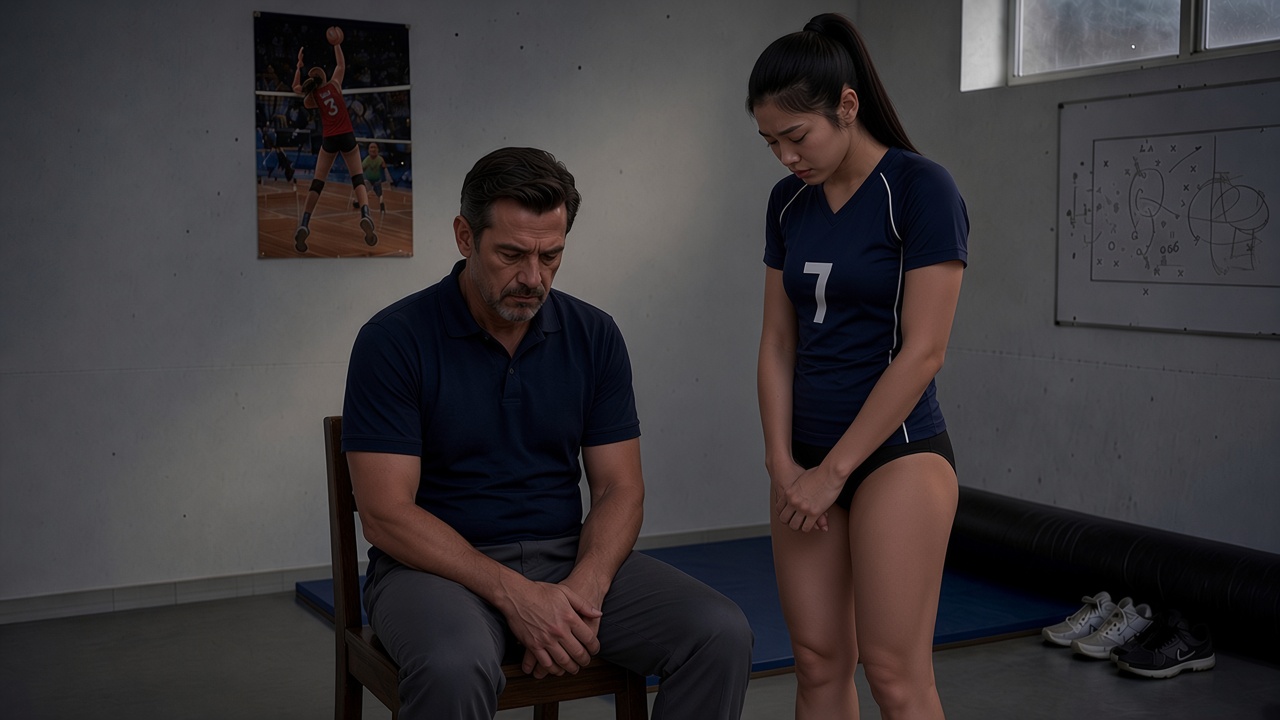
“Over my knee, Vale.”
I went. I lowered myself across his lap, clumsy with nerves and with the leftover shaking, my palms finding the mat, my hair falling forward. The gray of his trousers was rough against my stomach. His left arm settled across my waist, heavy and certain, and for a moment he only rested his right palm over the black fabric, still and unhurried, and the waiting was almost worse than anything that could come after. I could feel my heartbeat in my throat. The training room smelled of rubber and dust and the soap on his shirt.
“You will remember this team,” he said, low. “And you will remember what it costs to be the one they count on.”
“Yes, Coach,” I whispered.
He lifted his hand.
To be continued… The full chapter, uncensored and with exclusive images, continues on Fanvue: Read what happens next on Fanvue →
The story continues
Didn't want it to end?
Read the full chapter on Fanvue, with exclusive uncensored images and videos, and get new chapters before anyone else.
Read the rest free for 7 days →Free trial, only 10 spots

More Stories
The First Cigarette
Chloe, 20, was the friend Mr. Daniel Reyes trusted with his daughter. Then he learned she had given Sofía her first cigarette. When Chloe comes to the house and Sofía isn’t home, a very angry man is waiting — and he gives her a choice.
storyThe Hairbrush
Hannah, 23, came back to a quiet retreat house of her own free will and accepted its rules. Then she started falling for the stern nun who ran it, and one night Sister Agnes, who had begun to trust her, found her touching herself after lights-out. Now she stands in the Quiet Room before a very angry, very disappointed woman, and hands over the wooden hairbrush herself.